A Tiny Galileo Thermometer
On Tradition at the Changing of the Seasons by Elisa Gurulé


Dear Known and Unknown Friends,
My sister, Elisa Gurulé, is keeper of a very mysterious type of wisdom that I do not possess. That is, aptitude in the domestic realms. She is a literal Master Gardener and kitchen witch. So many of our traditions are lost to us. They can be revived and rekindled by a special sort of person, and she just happens to be one of those people. Below is a piece on the subject she was kind enough to contribute to A Tiny Compass. Thank you for your time and attention, as always.
LVX,
Alejandra
Our calendar calls January first the new year, but that’s not really right. We know that the new year doesn’t start until spring, even if the old year has most definitely wrapped up in the winter. The winter is a time of rest. We necessarily slow down to stay cocooned away from the cold and dark. It’s a time of internal life/work/reflection.
I always feel hopeful at the start of winter: this will be the year that I learn to sew, or knit. I will read more and so will my kids. We will finally find a board game that we can enjoy as a family. We will enjoy the time as cozy, not claustrophobic. I’ll introduce them to movies that I’ve wanted them to see. I’ll watch movies that I’ve wanted to see, things I’ve been putting off while I worked in the garden. I’ve been saving them for this season of snuggling in; I’ll put records on the turntable and we will enjoy music collectively. I’ll lean into the natural rhythm of the season, and I’ll give thanks for our little, sweet life. I’ll plan a fire for the night of the solstice. I will align and I will feel like life is moving on ball bearings, not bumpy pot-holed roads.
It’s still early enough in the winter that I’m hanging onto this idyllic image, but even admitting that it exists is to expose it to the oxidizing effects of reality. My children will bicker, my spouse and I will too. None of us can get enough space, no matter how far we spread out in the house. Family conversations will become strained and uneasy, heavy with things that we’ve never been able to work out. Not because things are harder for us, necessarily, but because being alive in community with other humans is hard, and the more we love each other, the higher the stakes feel in our miscommunications. To be misunderstood is so painful; to misunderstand is almost worse. For me, it feels like I lose the foundations of my own self. Wrong-footed, wrong-headed. Just wrong.
So I’ve searched and worked to find practices of living that allow me to right that sense of being all wrong, and like many people, I have found that working a garden has given me the closest thing I can find to peace, or communion. My garden is not show-worthy, nor is it anything extraordinary, it’s just a suburban yard. Every year, I dig up a bunch of stuff, move a bunch of other stuff around, plant yet other stuff. I’ve read so much lately about different kinds of gardening: native planting, planting for pollinators, companion planting, and so on. I love reading about the ways in which people arrive at their plans and designs for their gardens.
I spend hours staring at the spaces under my cultivation, trying to figure out how I can grow a whole Three Sisters Garden* (I can’t, there just isn’t enough space without sacrificing everything else) and also a cut flower garden (I don’t think I actually want that; they’re much more rigid than bouquets lead us to believe), and also enough vegetables to can for the winter (this is pure fantasy. I think this year finally cured me of that notion. I’m sure I’ll try again next year.) but also an English-style cottage garden* (once again, I’m forced to reckon with the fallacy of “nature” when I contemplate this). I try to find the line between where ego ends and stewardship begins, or (and?) where hubris interrupts it all. Although the garden is where we often find peace, the history and theory of gardening is far more unsettling.
Going back to the earliest Enclosure Acts, during the English transition from feudalism to capitalism, gardens represented leisure and dominance over nature. Lands that had been communally farmed, allowing peasants to feed themselves became status symbols for the wealthy landowning class. Marx wrote first about enclosure being a necessary forerunner to the development of capitalism. That is, privatising resources and using violence to destroy the communities that had previously used them, forcing them into what we might now recognize as an industrialized economy. Sylvia Federici brought the theory into contemporary times with her work, Caliban and the Witch: Women, the Body and Primitive Accumulation (2004). She continues to refine and adapt her thinking on this topic as the world changes and shifts*. I find myself thinking about this as I look out over my yard, annoyed that the view out my office window is the back of my neighbor’s garage, the pile of wheelbarrows, hoses and garbage cans reminding me that the idyll I imagine is not quite possible in our shared environment. The low chain-link fence marks the property line and keeps our dogs in their respective homes, but somehow it just highlights how arbitrary “my” yard is. The gift that I have grudgingly accepted from this is to realize how much I absolutely do not control, even as I endeavor to make my little space a haven for the living.
This past year, my surprise triumph was a patch of tithonia, also known as Mexican Sunflowers. I’m pretty sure I pulled a bunch of them by mistake before realizing that they weren’t weeds. A wild-looking annual, they bloom late in the summer and they are a hit among monarch butterflies and hummingbirds. Both of these winged creatures held important positions in the cosmology of the Indigenous people who would come to be known as the Aztecs, the ancestors of Mexicans, and both are also now symbols of the resilience of migrants coming to the US from Mexico and Central America. Tiny, delicate, airborne miracles that are also important pollinators, not just extracting what they need from the flowers they visit, but participating in the cycle of creation and sustenance. Every morning, I would open my front door and just stand on the porch watching their traffic. One day, I counted five butterflies on the patch at once. They also crowded out the other flowers in the bed, their stalks & leaves creating microclimates of dry shade in a bed of full sun. Insert your own obvious metaphor here. I gloried in that tithonia bed full of monarchs until well into October, their orange matching both the summer butterflies and the Halloween pumpkins.
Again, though, I come back to the question of ego/stewardship/hubris as motivation for all this sweat. Like much of the work in the garden, and my other retreat, the kitchen, this question is one that never offers a clear answer. Instead, it’s like one of those old-fashioned galileo thermometers full of mercury weights –rising and falling based on atmospheric pressure. Ego, stewardship, hubris in a constant dance for balance. I used to think it was a fight for dominance, but I understand now that’s not the case. Balance, not dominance, is the goal. The process of the growing is the joy; there is no moment when I can look at the garden – “my” garden – and declare it “Perfect,” or even “Very Good.” Almost nothing is beyond redemption. (Except autumn clematis and english ivy. Those are true nightmares, and they kill everything else around them.)
The garden offers me a place to both think deeply and unhitch my mind and allow myself to be just an embodied part of the landscape. The kitchen offers something similar, especially in big cooking projects –holiday meals, and especially The Tamalada. For the last several years, I’ve hosted a tamalada at my house in the winter frenzy before Christmas. I invite friends and family from across the phases of my life to my home and we make tamales together. Traditionally, it is done by women, and with family. I didn’t grow up like that, though, and it is not a tradition of my mother’s family, so I’ve created my own. Tamales come from a tradition that dates back to before the Spanish came to the Americas, by people who developed the very practice of agriculture from First Principles. Even the word tamal is older than the “new world” and corn we use to make masa is proof of an extraordinary capacity for tinkering, observing, problem-solving, troubleshooting. A grass known as teosinte, it was bred over thousands of years into maize, and still persists in its primeval form in some places. However, like so many plants and animals, it is threatened by the practices of industrial farming and habitat loss.
I begin preparing for the day weeks ahead of time, procuring the ingredients that are hard to come by in my suburban grocery stores and taking inventory of my pantry to see what I’ve stockpiled over the year. I make tamales from vegan ingredients, with squash and peppers for filling instead of the traditional pork or chicken. I use avocado oil instead of lard. The feeling mirrors the January perusal of seed catalogs and wintertime pencil-chewing as I consider the upcoming season.
This year, it will be on the 13th (tomorrow, so I’m stealing time to write this, even though I’ve got a To Do list a mile long. I could have written this any time in the last two weeks, but something about that has felt too indulgent. Sitting down to write as tasks and chores pile up, blotting out the gift that it is to be able to live in a home that needs tending, with a garden that allows cultivation and all of it in safety). I climb up on a ladder to see how many bags of hojas (corn husks) I have left on the highest shelves in my kitchen. I discover I have probably enough (maybe ask Mom to pick up a couple more, though…)
Not one to completely eschew tradition, I survey the deep freezer to take an inventory of manteca (lard) for the pork tamales that I also make, and climb yet another ladder to find that I have run out of New Mexico chili peppers. All I have left are hot, and those are brutal. My dad is from New Mexico and though he spent 45 years in Michigan before returning, his homesickness never left him. He passed a few particular traits to me. One of them is the conviction that New Mexico chiles (red and green) are superior to all others, for nearly every application, but especially for making tamales. He usually sends me a big package of them about once a year or so, but I forgot to ask him for them this year.
As I contemplate the bunch of other chiles I have available to me, I despair for a moment, thinking that my perfect chile colorado is ruined, and my reputation for my beautiful, joyful tamalada will be sunk. The mercury weights of the ego/stewardship/hubris galileo thermometer bob in my mind for a few minutes before I am able to place things in their proper context.
I think about my empty bag of the specific chile peppers that I want and I can’t help but laugh at myself. As though that tiny problem can’t be Macgyvered with a simple solution. I look at my own notes I keep in my kitchen, back at the ones I’ve written on the garden, and do a quick search online, cross-referencing it all with what I remember of the flavors and heat levels of the peppers in the pantry. I come up with a very good substitution: about half guajillo and half ancho, of which I have tons. In fact, that’s probably why I have so many. I’ve run into this problem before, and solved it in the same way. The weights of the galileo thermometer drift back into balance: ego sinks, stewardship rises. Hubris holds steady as I strut around my kitchen calling myself a MexiCAN, not a MexiCAN’T while also recognizing that having to solve the same problem year after year, in the same way, should probably keep me humbler. Like I said, balance.
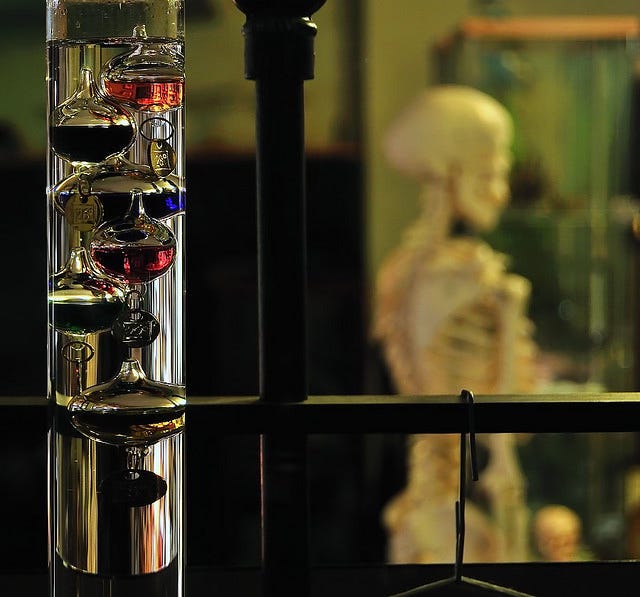
A Galileo Thermometer. Picture shamelessly stolen from the internet. My entire life I’ve thought these things were just decorative trinkets. When my boyfriend saw the picture, he thought it was some sort of space bong. As it turns out, science. -AV
Notes:
*Enclosure Acts: https://sites.udel.edu/britlitwiki/the-enclosure-acts/
*https://www.agrariantrust.org/enclosure-old-and-new/
*https://www.aav.org/news/615010/The-Hummingbird-in-Mexican-Culture.htm
*https://monarchjointventure.org/blog/monarchs-and-dia-de-muertos-in-mexico
*The Three Sisters is a Mesoamerican method of interplanting corn, beans and squash. First, the corn, which has the longest growing season. Once the corn is a few inches high, beans and squash get planted in the same rows with them. As the corn grows, it provides a structure for the beans to climb. The squash vines, growing along the ground, suppress weeds that would otherwise out-compete corn and help keep water from evaporating as quickly. Corn is a thirsty crop, so this is an important service. Beans help to fix nitrogen in the soil and their blooms also attract pollinators (hummingbirds love them!), which is critical for corn, as it does not self-pollinate easily.
 | A guest post by
|
Thank you for welcoming into your space and giving me the push to work on this little meditation.